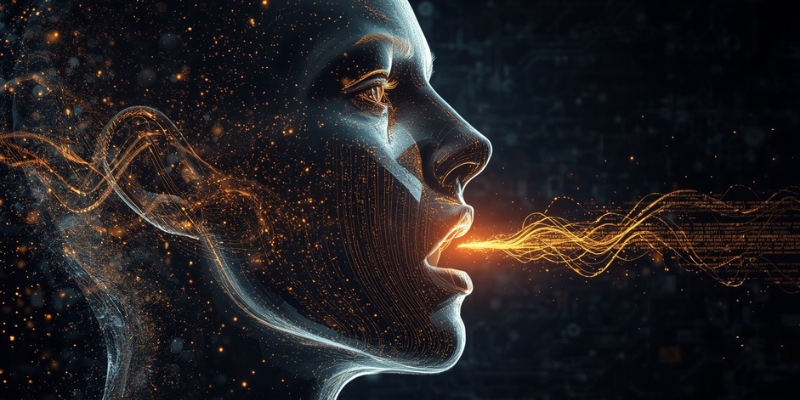
The human voice carries far more than words. It carries accent, emotion, identity, history. That’s why AI voice cloning is simultaneously one of the most fascinating and most unsettling innovations of recent years — a technology capable of reproducing with striking precision what we always considered irreproducible.
How it works
Modern voice cloning systems need just a few minutes of audio to create a functional replica. Deep learning algorithms analyze patterns of frequency, rhythm, timbre, and intonation — then reconstruct a synthetic voice capable of pronouncing any text with the original speaker’s cadence. What once required studios, voice actors, and hours of recording can now be done with an audio file and a few clicks.
The pros: accessibility, preservation, and translation
The benefits are tangible. In medicine, people who lose their voice to diseases like ALS can preserve it digitally before deterioration sets in — and continue “speaking” in their own sonic identity for years.
In entertainment and education, the technology allows content to be localized into multiple languages while keeping the original presenter’s or teacher’s voice. A documentary narrated in English can be heard in Spanish, Japanese, or Arabic — with the same voice, the same tone, the same authority.
This is where voice cloning intersects directly with the world of translation and interpretation. Tools like HeyGen and ElevenLabs already allow entire videos to be dubbed while preserving the cloned voice of the original speaker. For global companies, content creators, and multilingual institutions, this is a revolution: the same speaker can address audiences in dozens of languages without recording a single additional line.
The cons: fraud, consent, and identity
The risks are proportional to the technology’s power. Scams using cloned voices of family members have already deceived thousands of people worldwide — fake calls requesting urgent money transfers, in a recognizable voice, with a convincing tone.
In the political arena, the disinformation potential is serious. Fake audio of leaders making statements they never gave can circulate within seconds, before any verification is possible. The voice — always considered proof of presence — can no longer be trusted.
There is also a central ethical question: consent. Who authorizes the use of their own voice? For how long? For what purposes? Actors, voice-over artists, and professional interpreters already face contracts seeking to capture their voice for perpetual AI use — often without proportional compensation.
The future of voice
Voice cloning is not going away — it will become more precise, more accessible, and more regulated. The challenge is to build a legal and ethical framework before the technology advances beyond our ability to control it.
The voice was always what made us unmistakable. AI has just learned to mistake it.